
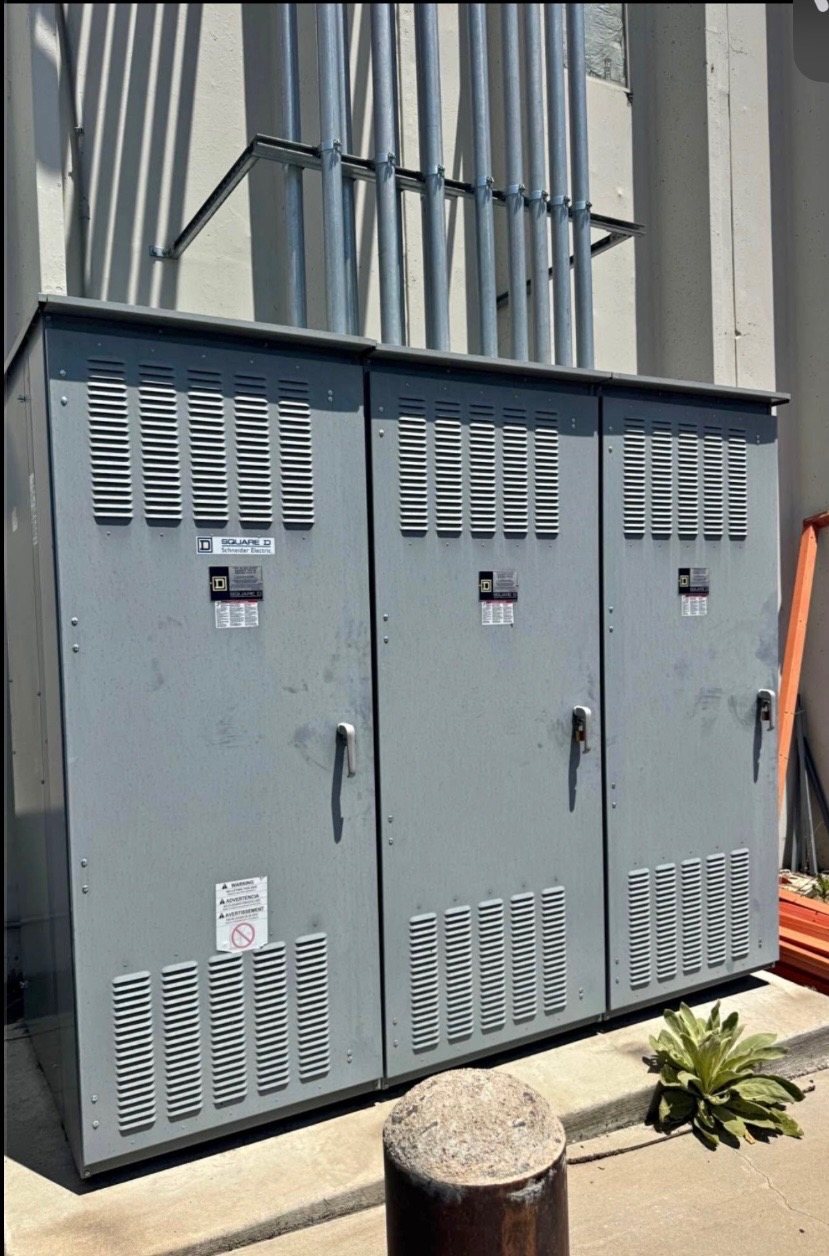
Selling switchboards: what to share
If your business owns switchboards in Maryland that is no longer needed, you can contact us about selling it. We are an equipment buyer: we review used and surplus assets and may make a cash offer. The scope can range from a single item to a larger group, depending on what you are authorized to sell. The offer depends on the information and equipment involved, not an assumed value for every unit. We consider all voltage classes and do not require seller testing. If the label or an existing record indicates 480 V, share the marking as written and note which item it describes. A voltage designation alone does not establish condition, compatibility or value.
A switchboard may contain a main section, distribution sections and multiple feeders, so the scope of the proposed sale matters. Tell us how many cabinets are involved and which sections, devices or loose accessories are included. An exterior image and a readable assembly nameplate, when already safely accessible, can help connect the rating to the equipment. If there are records of modifications, share what you know and identify any uncertainty. Do not infer short-circuit capacity or present operating condition from a single ampere number; we review the available information as a whole.
Photographs work best when they are tied to the seller's description. A safely available wide exterior view can show the number and arrangement of sections, while a readable external nameplate can provide the manufacturer's identification and ratings. If a label is inaccessible or unreadable, tell us what is available instead. Do not enter a hazardous area, open doors or covers, operate equipment, or approach guarded interiors to get a picture. There is no seller testing requirement; we can begin with whatever information can be provided safely.
Records, condition and the scope of the sale
When several departments are involved, one contact may know the equipment while another has authority to approve a sale. It is useful to identify a commercial contact and, if different, someone who can discuss the site's access requirements. You can also explain whether the assets are in one area or spread across several locations. That information is for coordination, not a request for you to remove equipment. Our team handles the required logistics and arranges qualified personnel for disconnects.
If you have a drawing or equipment schedule, it can be useful context, but be clear about its date and whether it reflects the present configuration. A drawing may cover assets that are not part of the sale, and a later modification may not appear on an older plan. Never disclose sensitive site material publicly merely to prepare an inquiry. Tell us what records exist and share only material you are authorized to provide. Our discussion can begin even if the only information available is a basic description and the equipment location.
Buyer-handled rigging and logistics
For heavy or multi-section assemblies, a building's route and access requirements can matter as much as the equipment list. Share any existing information about stairs, doors, loading docks, site gates or restricted areas, but do not put yourself at risk trying to investigate them. Let us know if there are visitor requirements or a site contact who can discuss access. Our team arranges the necessary disconnects, rigging and removal, including any crane work, loading, hauling and paid freight. No seller testing or physical work is required.
If more than one organization is involved at the property, tell us who can discuss the offered equipment and who controls access to the site. An owner, contractor and facility manager may have different responsibilities, and the sale should cover only assets the seller is authorized to offer. Gate rules, access hours and an existing equipment inventory can be useful for planning. We handle the physical work and logistics, including qualified disconnects and paid freight, rather than asking the seller to move or load an assembly.
Cash offer and upfront payment
Start with the equipment description and any safely available exterior photographs, along with your contact and location details. We review the information and can make a cash offer based on the actual equipment and circumstances; not every inquiry results in an offer. If the parties agree to a sale, payment is made upfront. Our team then coordinates the necessary disconnects and physical logistics, including rigging, loading, hauling and freight. All freight is paid by us. You do not need to test the equipment, operate it, or take on the removal work.
Owners sometimes know the history of an asset in broad terms but lack records of every service or modification. That is useful context when described accurately: distinguish a known storage period, for example, from a guess about whether the equipment would operate. Mention external damage, missing labels or separately stored parts if they are known. We do not ask the seller to prove functionality with a test. A straightforward account of condition and uncertainty is more helpful than an unsupported assurance.